Architecture
Overview
APIHUB is described by two models that meet in the middle. The C4 model answers how the platform is built. The capability map answers what it does. Every sub-capability names the container that implements it, and every container appears in the C4 diagrams.
Two models, one source
Architecture documentation usually fails in one of two ways: it describes boxes nobody can map to a repository, or it lists features nobody can map to a runtime. APIHUB is documented from both ends, and the two descriptions are kept consistent by sharing one model file.
Model one · C4
“How is it built?”
Four levels of zoom, from a single box on a context diagram down to the registries and pipelines that matter in the code. Plus a deployment view and three dynamic views.
Model two · capability map
“What does it do?”
A capability is a stable statement of what the platform does, so it survives refactoring. Nine of them, broken down into 60 sub-capabilities with technology and maturity overlays.
Where they meet. The technology overlay on the capability map colours each sub-capability by the container that owns it. Change the model once and both descriptions follow — which is why the capability data on this site is imported from the same file that generates the architecture slide deck.
The four levels of C4
Each level answers exactly one question and deliberately hides the detail of the next. If a diagram makes you ask “but what is inside that box?”, the answer is on the level below.
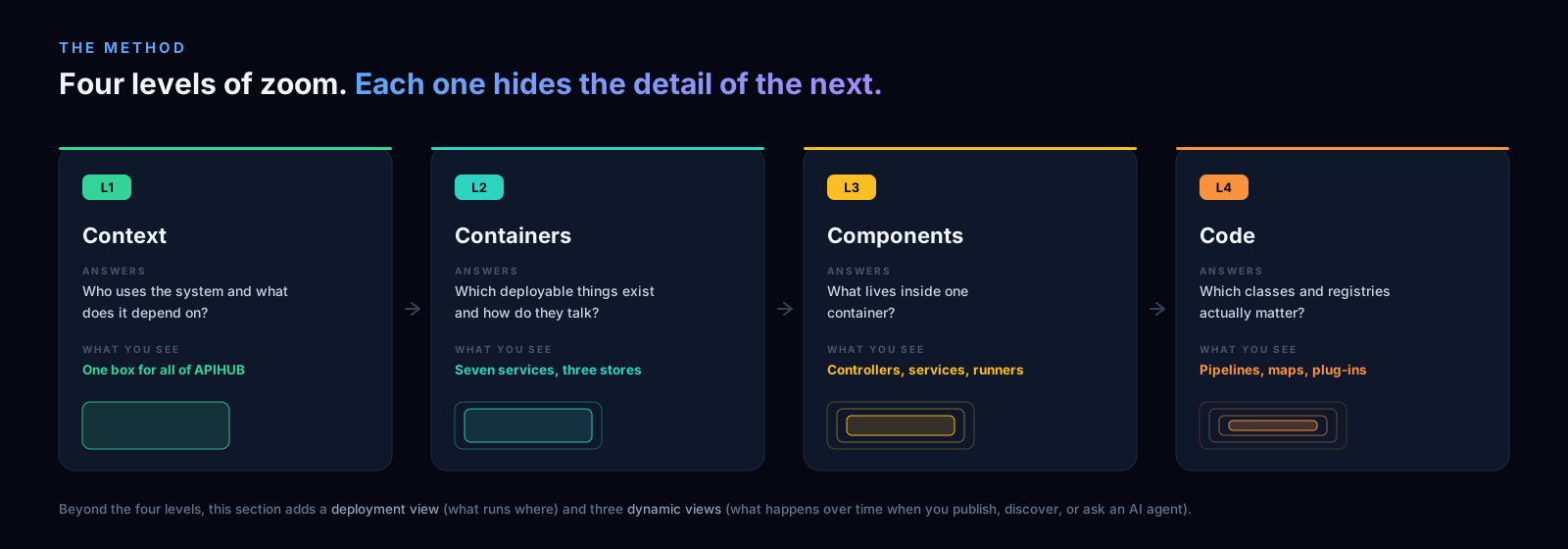
Context
Who uses the system and what does it depend on?
One box for all of APIHUB
Containers
Which deployable things exist and how do they talk?
Seven services, three stores
Components
What lives inside one container?
Controllers, services, runners
Code
Which classes and registries actually matter?
Pipelines, maps, plug-ins
The platform in one glance
Seven containers get deployed. A further twelve TypeScript libraries are not deployed on their own, but they are where parsing, diffing and rendering actually happen.
What to read next
The C4 model
Context, containers, components and code — plus what runs where in Kubernetes.
Runtime flows
What happens over time when you publish a version, run discovery, or ask an AI agent.
Capability map
Sixty sub-capabilities with technology and maturity overlays, and the ArchiMate view.
These pages are derived from the APIHUB architecture deck (September 2026). The capability data is imported from the deck's model file, so the two stay in step. Source code for every container lives under Netcracker on GitHub.