Architecture
Capability map
A capability is a stable statement of what the platform does, so it survives refactoring. Nine of them cover APIHUB, broken down into 60 sub-capabilities. Switch on the technology overlay and the map becomes a functional-technical view: every entry names the service that implements it.
Nine capabilities, three tiers
Core
The reason the product existsAPI Catalog Management
Own the registry of workspaces, packages and versions
6 sub-capabilities
API Publishing & Build
Turn uploaded sources into normalized, indexed API versions
7 sub-capabilities
API Change Management
Understand what changed between versions and how risky it is
6 sub-capabilities
API Documentation & Consumption
Let consumers read, try and export APIs
7 sub-capabilities
API Quality & Governance
Enforce standards and measure API quality
7 sub-capabilities
API Discovery (runtime)
Find APIs running in Kubernetes and bring them into the catalog
6 sub-capabilities
Differentiating
Rare in an API registryAI & Ecosystem Integration
Expose the catalog to AI tools and manage non-API contracts
8 sub-capabilities
Supporting
Needed to operateIdentity & Access
Authenticate users, machines and agents; authorize actions
6 sub-capabilities
Platform Operations
Run, scale, observe and maintain the platform
7 sub-capabilities
All 60 sub-capabilities
The full functional picture. The two overlays are the point of this map: one tells you which container to open when you need to change something, the other tells you how much production history that area has.
API Catalog Management
6- C1.1 Workspace / group / package hierarchy
BE + UI Core / mature
PackageService, go-pg, Portal catalog pages
- C1.2 Version & revision lifecycle
BE + UI Core / mature
VersionService / PublishedService, status promotion, revisions
- C1.3 Dashboards & references
BE + UI Core / mature
Dashboard packages, version references, recursive resolution
- C1.4 Search & navigation
BE + UI Core / mature
SearchController v3/v4, PostgreSQL full-text
- C1.5 Favorites & activity history
BE + UI Core / mature
ActivityTracking, favorites, publish history
- C1.6 Soft delete & transitions
BE Core / mature
TransitionService, soft-deleted cleanup, package move
API Publishing & Build
7- C2.1 Publish via UI / REST / CI
BE + UI Core / mature
PublishController, api-key / PAT auth, ZIP or multipart sources
- C2.2 Build task queue & workers
BE + BTC Core / mature
BuildService DB queue, RegistryService polling, N stateless replicas
- C2.3 Parsing & type detection
BTC + LIB Core / mature
PackageVersionBuilder, 7 ApiBuilders, resolveSpec()
- C2.4 Normalization
BTC + LIB Core / mature
api-unifier RULES per SpecType, $ref resolution, allOf merge
- C2.5 Operation extraction & indexing
BTC + BE Core / mature
buildOperations, build-result-index, BuildResultService
- C2.6 Document groups & transformations
BE + BTC Evolving
TransformationService, merged / reduced specs, prefix groups
- C2.7 Java API builds
JTC Planned / partial
jdiff-engine, japicmp, jdeps; backend java-builders queue pending
API Change Management
6- C3.1 Version & operation comparison
BTC + LIB + BE Core / mature
api-diff COMPARE_ENGINES_MAP, ComparisonService, compare pages
- C3.2 Change classification
LIB Core / mature
breaking / risky / non-breaking / semi-breaking / annotation / deprecated
- C3.3 Changelog & summaries
BTC + BE + UI Core / mature
ChangelogStrategy, changes/summary endpoints, export of changes
- C3.4 Backward-compatibility validation
BTC + LIB Evolving
components/compare/*.bwc.validation (rest, graphql, async, ddl)
- C3.5 Deprecation tracking
BE + UI + LIB Core / mature
deprecated items per operation, deprecated summaries
- C3.6 Contract diff (DDL, Java)
LIB + JTC New (2026)
compareDdlApi (ddlapi-1.0); ApiDiffPipeline for jars (planned)
API Documentation & Consumption
7- C4.1 Operation documentation rendering
UI + LIB Core / mature
<apispec-view>, <operation-view>, api-doc-viewer
- C4.2 Schema & model views
UI + LIB Core / mature
JsonSchemaViewer, GraphQLOperationViewer, api-data-model trees
- C4.3 Class / UML diagrams
UI + LIB Core / mature
<class-view-component> (D3 + ELK)
- C4.4 Interactive playground
UI + BE + LIB Core / mature
<rest-playground>, PlaygroundProxyController, allowed hosts
- C4.5 Markdown & text documents
UI + BTC Core / mature
textApiBuilder, MarkdownViewer with Mermaid
- C4.6 Export (HTML, xlsx, ZIP)
BE + BTC Evolving
ExportService / ExcelService (excelize), export strategies, templates
- C4.7 Document shareability
BE + UI New (2026)
shareability flags, bulk update, shareability report xlsx
API Quality & Governance
7- C5.1 Specification linting
LNT Core / mature
SpectralExecutor (bundled CLI), Olric event trigger
- C5.2 AI-assisted linting
LNT Evolving
AIOasExecutor, OpenAI-compatible LLM, rate limits
- C5.3 Ruleset management
LNT + UI Core / mature
RulesetService CRUD / activation, Portal settings
- C5.4 Version quality scoring
LNT + UI New (2026)
ScoringService, api-quality page
- C5.5 Bulk validation
LNT Evolving
bulkValidation jobs
- C5.6 Operation groups & tagging
BE + UI Core / mature
OperationGroupService, groups per apiType, templates
- C5.7 Release readiness & statuses
BE + UI Core / mature
version statuses (draft/release/archived), promote permissions
API Discovery (runtime)
6- C6.1 Agent registration & health
AGT + ABE Core / mature
RegistrationService heartbeat ~30 s, AgentService registry
- C6.2 Namespace & service discovery
AGT Core / mature
CloudService (client-go), caches, workspace-scoped v2/v3 APIs
- C6.3 Specification probing
AGT Core / mature
DiscoveryRunners: REST, GraphQL, AsyncAPI, Markdown, JSON Schema, generic
- C6.4 Snapshots & promotion to Portal
ABE + BE Core / mature
SnapshotService → publish dashboard versions
- C6.5 Namespace security checks
ABE + AGT Evolving
NamespaceSecurityService auth-check, Excel report
- C6.6 Service proxy
ABE + AGT Core / mature
proxy controllers, ServiceProxy to in-cluster services
AI & Ecosystem Integration
8- C7.1 MCP server (catalog tools)
BE Evolving
mcp-go Streamable HTTP, search / spec / diff / document tools, resources, prompts
- C7.2 AI chat assistant
BE + UI New (2026)
AiChatTurnService, openai-go, SSE, tool loop, ephemeral files
- C7.3 IDS document authoring
BE New (2026)
IDS authoring kit prompt + chat tools (MCP assets)
- C7.4 MCP catalog contracts
BE + BTC + UI New (2026)
mcpBuilder, MCPContractController, Contracts tab
- C7.5 DDL (database) contracts
BE + BTC + LIB + UI New (2026)
ddlBuilder, ddlapi-1.0 SpecType, DDLContractController
- C7.6 Linter MCP endpoint
LNT New (2026)
list_linter_issues_for_package_version
- C7.7 CLI & local MCP tooling
LIB Evolving
aux-tools/apihub-api-diff CLI + MCP subcommand
- C7.8 API gateway sync (Tyk)
design only Planned / partial
qubership-apihub-tyk-adapter — design only
Identity & Access
6- C8.1 SSO authentication
BE Core / mature
SAML 2.0 (crewjam), OIDC (go-oidc), IDPManager, LDAP lookup
- C8.2 Local accounts & sessions
BE Core / mature
local auth (non-prod), JWT access + refresh, cookie / bearer
- C8.3 API keys & personal access tokens
BE + UI Core / mature
ApihubApiKeyService, PersonalAccessTokenService, scopes
- C8.4 Role-based access control
BE + UI Core / mature
RoleService: system, package, custom roles; permissions API
- C8.5 Token propagation to satellites
LNT + ABE + AGT Core / mature
JWT public key validation, api-key / PAT strategies in each service
- C8.6 User & admin management
BE + UI Core / mature
UserController, SysAdminController, avatars, zero-day admin
Platform Operations
7- C9.1 Deployment & configuration
OPS Core / mature
Helm chart, values.yaml, config.yaml per service, docker-compose variants
- C9.2 Data storage
BE + LNT + ABE Core / mature
PostgreSQL per service, optional S3 / MinIO cold storage
- C9.3 Distributed cache & events
BE + LNT Core / mature
Olric embedded (cache, locks, DTopic version-published)
- C9.4 Scheduled maintenance
BE + LNT + ABE Core / mature
robfig/cron cleanup jobs, VACUUM, ephemeral files, chat retention
- C9.5 Schema & data migrations
BE + LNT + ABE Core / mature
migration framework, operations migration FSM
- C9.6 Observability
BE + OPS Evolving
Prometheus metrics, ServiceMonitor, Grafana dashboards, business metrics
- C9.7 CI/CD & E2E testing
OPS Core / mature
qubership-apihub-ci workflows, Newman, Playwright, screenshot tests
Where the weight sits
Sub-capabilities per container
- APIHUB Backend 34
- APIHUB UI 24
- TypeScript libraries 13
- Build Task Consumer 12
- API Linter Service 11
- Agents Backend 8
- APIHUB Agent 6
- Platform / Helm 3
- Java Task Consumer 2
Maturity across all sixty
- Core / mature 41
Stable for several releases, full test coverage (E2E, Newman / Playwright)
- Evolving 9
Actively changed in 2026 (new endpoints, renamed tools, partial coverage)
- New (2026) 8
Landed in the last release cycle; limited production history
- Planned / partial 2
Specified or partially implemented; not usable end-to-end yet
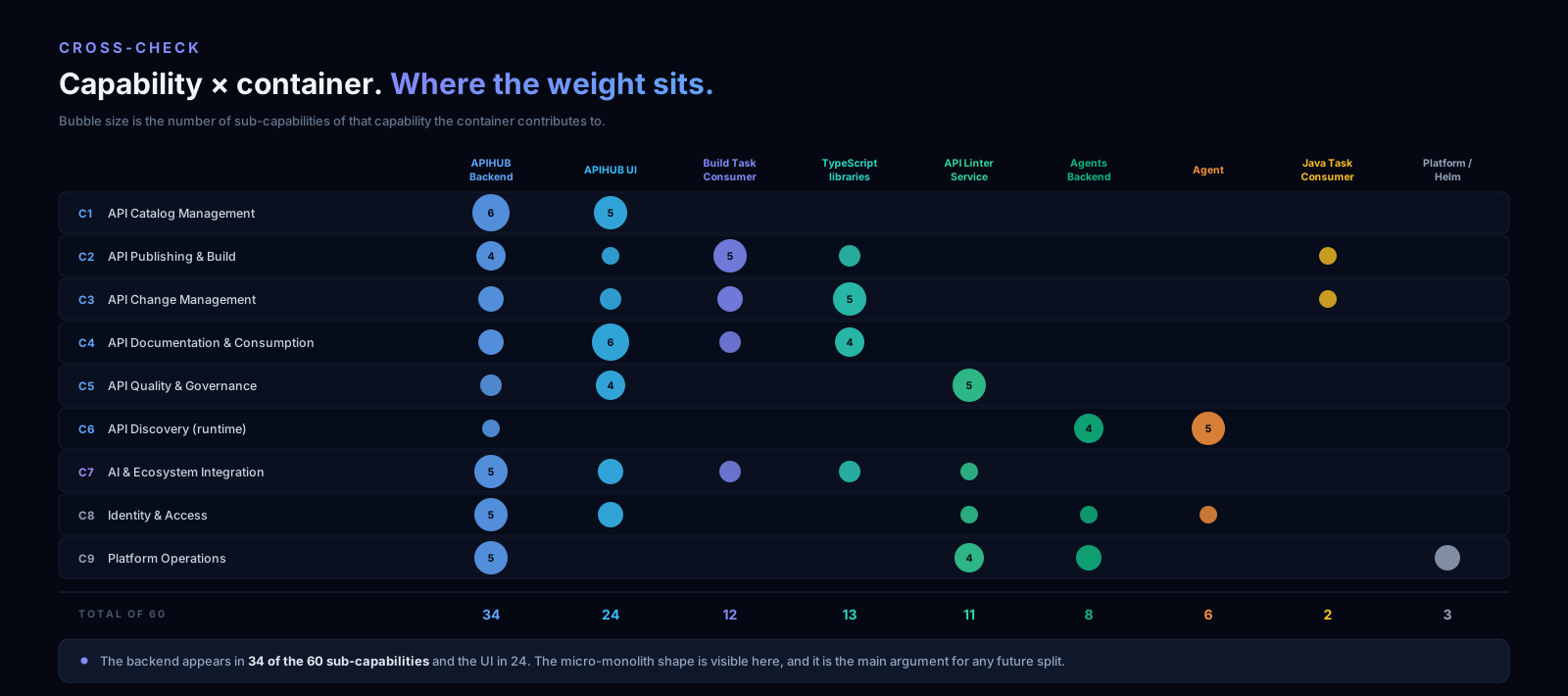
The backend appears in 34 of the 60 sub-capabilities and the UI in 24. The micro-monolith shape is visible here, and it is the main argument for any future split.
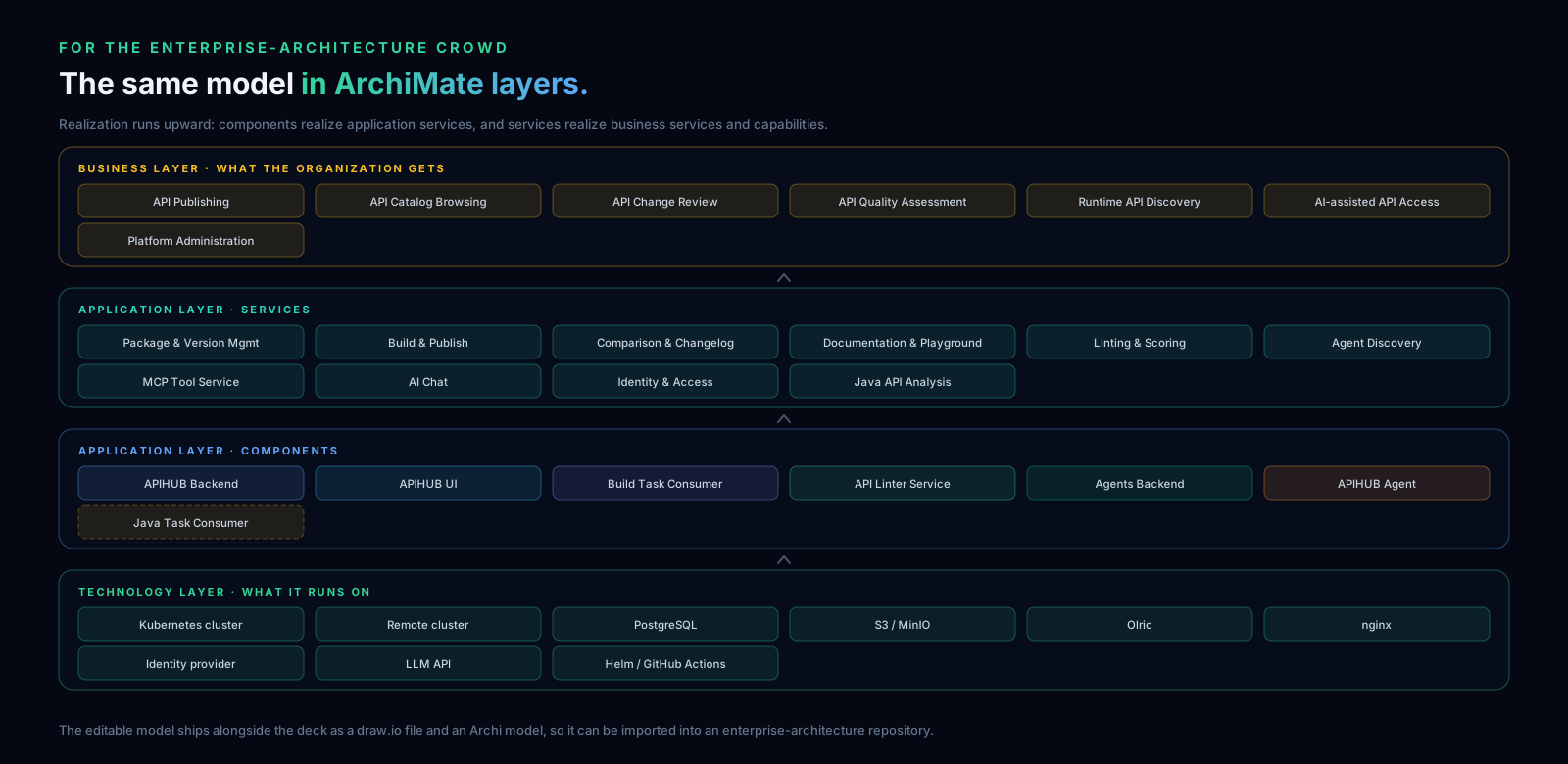
The same model in ArchiMate
For readers who need to import this into an enterprise-architecture repository: business services on top, application services and components in the middle, technology underneath. Realization runs upward.