APIHUB system architecture
1. System overview
Section titled “1. System overview”APIHUB is an API management and registry platform. It stores, analyzes, compares, and documents API specifications and contracts in one catalog. It supports OpenAPI and Swagger, GraphQL, AsyncAPI, DDLAPI database-schema contracts, Markdown, Protobuf and gRPC stubs, and MCP catalog contracts. The backend also exposes a separate MCP server with API-catalog tools for AI integrations.
APIHUB runs on Kubernetes. The repository holds the source of every component, so each component below maps to a folder of the monorepo. The landing site shows the same system from other angles:
- C4 diagrams: context, containers, and deployment.
- Flows: publish, discovery, and AI review.
- Capability map: what each component contributes to each capability.
2. Containers
Section titled “2. Containers”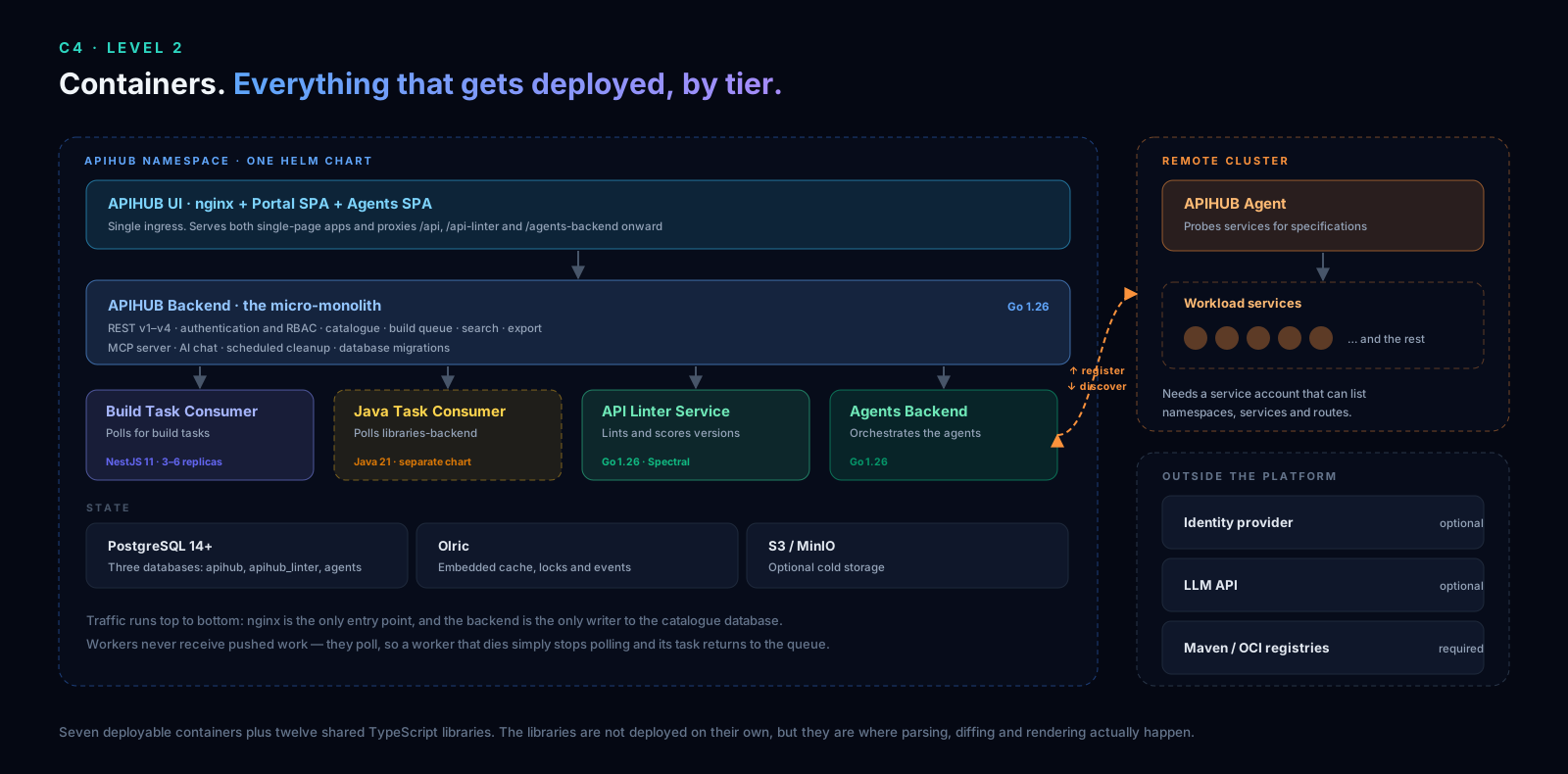
The Portal UI is the single entry point. Its nginx proxy routes /api/* to the API Registry, /api-linter/* to the
API Linter service, and /agents-backend/* to the Agents backend. Workers poll the API Registry for build tasks, and
the registry stores their results in PostgreSQL.
2.1 Layers
Section titled “2.1 Layers”| Layer | Module | Language | Port | Role |
|---|---|---|---|---|
| Portal UI | frontend/ui |
TypeScript, React, nginx | 8080 | Two SPAs (Portal and Agents) behind an nginx reverse proxy: the entry point for users and operators. |
| API Registry | backend/portal-backend |
Go | 8080 | Central micro-monolith: REST API, authentication, RBAC, packages and versions, build orchestration, MCP server, AI chat, cleanup jobs. |
| Builder | frontend/build-task-consumer |
TypeScript, NestJS | 3000 | Stateless workers that run the TypeScript processing stack: normalize, diff, changelog, export. |
| Java task consumer | backend/java-task-consumer |
Java | none | Stateless workers that take the Java build tasks (jar-to-jar API diff and dependency-upgrade impact analysis) that backend/libraries-backend queues. |
| Extension: API Linter | backend/api-linter-service |
Go | 8080 | Lints API specifications with Spectral and AI engines; optional version quality scoring after a lint run. |
| Extension: Agents backend | backend/agents-backend |
Go | 8080 | Manages agent instances, snapshots, and namespace security. |
| Agent | backend/agent |
Go | 8080 | Runs in a customer cluster, discovers APIs through pluggable runners, and reports them to the Agents backend. |
The shared infrastructure is PostgreSQL (separate databases per service), optional S3 or MinIO cold storage, and Olric for the distributed cache and publish-subscribe events.
3. Data flow
Section titled “3. Data flow”3.1 Publish Flow (User uploads API spec)
Section titled “3.1 Publish Flow (User uploads API spec)”User → UI → Backend (POST /api/v2/packages/{id}/publish) ↓ Backend creates build task in DB ↓ Builder polls (POST /api/v2/builders/{builderId}/tasks) ↓ Consumer receives ZIP (config + source files) ↓ PackageVersionBuilder.run() via api-processor: 1. Parse files → detect API or contract type (REST/GraphQL/AsyncAPI/DDL/MCP/Markdown/Unknown) 2. Build documents (VersionDocument objects) 3. Extract operations (per HTTP method / per GraphQL query) 4. Normalize via api-unifier 5. Compare with previous version via api-diff 6. Generate changelog (classified diffs: breaking/non-breaking/risky) 7. Package results as ZIP ↓ Consumer sends results back (POST /api/v3/packages/{id}/publish/{publishId}/status) ↓ Backend stores results in PostgreSQL ↓ Backend publishes "version-published" event via Olric DTopic ↓ API Linter receives event → fetches docs → runs Spectral/AI lint → stores results3.2 Agent Discovery Flow
Section titled “3.2 Agent Discovery Flow”Agent (in remote K8s cluster): 1. Registers with Agents Backend on startup (heartbeat every ~30s) 2. User triggers discovery via Agents UI 3. Agent lists K8s namespaces/services 4. For each service, runs all DiscoveryRunners in parallel: - REST runner: probes Swagger/OpenAPI endpoints - GraphQL runner: GraphQL introspection - AsyncAPI runner: AsyncAPI document endpoints - Markdown runner: Markdown document URLs - JSON Schema runner: JSON Schema URLs 5. Returns discovered documents to Agents Backend 6. User can create "snapshot" → Agents Backend packages specs → publishes to Backend3.3 View/Compare Flow (User views API in UI)
Section titled “3.3 View/Compare Flow (User views API in UI)”User → UI → Backend (GET /api/v2/packages/{id}/versions/{v}/{apiType}/operations) ↓ Backend returns operations/documents from PostgreSQL ↓ UI renders via web components: - <apispec-view> for full API documentation (OpenAPI/AsyncAPI) - <operation-view> for single operation detail - <diff-operation-view> for version comparison - <rest-playground> for interactive API testing - <class-view-component> for UML-style schema diagrams - JsonSchemaViewer / GraphQLOperationViewer for schema rendering4. TypeScript library stack
Section titled “4. TypeScript library stack”The processing pipeline behind the builder and the UI is a layered stack of 13 TypeScript libraries in
frontend/. json-crawl is the foundation. api-unifier normalizes specifications and
defines the SpecType union (openapi-3.0, openapi-3.1, json-schema-04/06/07, asyncapi-3, graphapi,
ddlapi-1.0). api-diff compares two normalized specifications and classifies each change. api-processor
orchestrates builds through PackageVersionBuilder, which registers one ApiBuilder per API type (REST, GraphQL,
AsyncAPI, DDL, MCP, text, unknown). api-doc-viewer, apispec-view, rest-playground, and class-view render the
results.
Processing libraries has the layer diagram, the dependency graph, and a catalog of every library.
5. Supported API types
Section titled “5. Supported API types”| API Type | Backend | Build Consumer | Agent Discovery | UI | Unifier | Diff | Model trees | Doc Viewer | Linter |
|---|---|---|---|---|---|---|---|---|---|
| OpenAPI 3.0/3.1 | ✅ rest |
✅ Rest |
✅ REST runner | ✅ | ✅ | ✅ | ✅ (JSON Schema) | ✅ | ✅ Spectral+AI |
| Swagger 2.0 | ✅ (via conversion) | ✅ (→ OAS3) | ✅ | ✅ | (→ OAS3) | (→ OAS3) | ✅ | ✅ | ✅ Spectral+AI |
| GraphQL | ✅ graphql |
✅ GraphQL |
✅ GraphQL runner | ✅ | ✅ (graphapi) | ✅ | ✅ (GraphApi) | ✅ | ❌ |
| AsyncAPI | ✅ asyncapi |
✅ Kafka (enum label; AsyncAPI build) |
✅ AsyncAPI runner | ✅ | ✅ asyncapi-3 |
✅ | ⚠️ partial vs REST | ✅ (apispec-view) | ✅ Spectral (+ scoring) |
| Protobuf/gRPC | ✅ protobuf |
✅ gRPC |
❌ | ❌ | ❌ | ❌ | ❌ | ❌ | ❌ |
| Markdown | — | ✅ MD |
✅ MD runner | ✅ viewer | — | — | — | — | — |
| DDLAPI | ✅ contracts | ✅ ddlBuilder |
❌ | ⚠️ contracts | ✅ ddlapi-1.0 |
✅ | — | ✅ | ❌ |
| MCP contracts | ✅ contracts | ✅ mcpBuilder |
❌ | ✅ Contracts tab | ❌ (not a SpecType) | ❌ (not a SpecType) | — | raw/contract views | ❌ |
MCP catalog contracts are distinct from the backend’s MCP server. The server exposes APIHUB catalog tools to MCP clients; it is not a catalog document type.
6. Authentication and authorization
Section titled “6. Authentication and authorization”Authentication Methods
Section titled “Authentication Methods”- Local Auth (non-production): username/password → JWT
- SAML 2.0: Enterprise SSO via SAML identity providers
- OIDC (OpenID Connect): OAuth2-based SSO
- LDAP: User directory sync
- API Keys: Service-to-service authentication
- Personal Access Tokens (PATs): Developer automation
- Cookie-based JWT: Browser session management
Authorization Model (RBAC)
Section titled “Authorization Model (RBAC)”- System Admins: Full system access
- Package-level roles: Viewer, Editor, Owner (per workspace/group/package)
- Custom roles: Configurable role definitions with granular permissions
- API Key scopes: Per-key permission grants
7. Deployment architecture
Section titled “7. Deployment architecture”Kubernetes (production)
Section titled “Kubernetes (production)”- The Helm chart lives in
deploy/helm-templates. - Every service runs as a Kubernetes Deployment with a Service.
- The nginx-based UI is the single ingress point.
- Each service exposes
/readyand/livehealth endpoints. - Production needs 2-11 CPU and 3-9 Gi RAM.
- Prometheus and Grafana dashboards are included.
Docker Compose (development)
Section titled “Docker Compose (development)”- The stacks live in
deploy/docker-compose.apihub-genericruns all services and PostgreSQL. with-keycloakadds a Keycloak server for SSO testing.
Local Kubernetes quickstart (optional analytics)
Section titled “Local Kubernetes quickstart (optional analytics)”deploy/helm-templates/local-k8s-quickstartcan add an Apache Superset subchart for BI and analytics next to the stack.
For install steps see the installation guide; for every setting see the configuration reference.
Infrastructure dependencies
Section titled “Infrastructure dependencies”| Component | Required | Purpose |
|---|---|---|
| PostgreSQL 14+ | Yes | Primary data store (separate databases per service) |
| S3 / MinIO | Optional | Cold storage for build results |
| Olric | Built-in | Distributed cache and publish-subscribe (LAN discovery in Kubernetes) |
| OpenAI API | Optional | AI-powered linting and chat |
8. Extension points for API and contract types
Section titled “8. Extension points for API and contract types”An API type represented by SpecType is normalized and usually diffed as a specification. DDLAPI is such a type:
its canonical value is ddlapi-1.0. MCP catalog data is deliberately different: it is a processor contract type
handled by mcpBuilder, not a classic ApiType or SpecType. The backend MCP server is a separate integration
endpoint.
Contract types: MCP and DDL
Section titled “Contract types: MCP and DDL”mcpBuilder and ddlBuilder are registered through processor contract constants (MCP_CONTRACT_TYPE and
DDL_CONTRACT_TYPE). Their document types are persisted by backend document/contract models and rendered in the Portal
Contracts tab via contract-types.ts. DDL additionally has a DDLAPI processing and comparison pipeline; MCP catalog
contracts organize endpoint initialization, tools, resources, and prompts without becoming operation APIs.
Adding another SpecType
Section titled “Adding another SpecType”The following roadmap describes adding another first-class specification type (for example, the earlier AsyncAPI
integration), rather than adding MCP as a SpecType.
Layer 1: Format Definition
Section titled “Layer 1: Format Definition”- Define the canonical source or intermediate format when required (for example,
graphapifor GraphQL).
Layer 2: Normalization (frontend/api-unifier)
Section titled “Layer 2: Normalization (frontend/api-unifier)”- Add the new value to
SpecTypeinsrc/spec-type.ts - Add detection in
resolveSpec()function - Create a dedicated normalization-rules module
- Register in
RULESmap
Layer 3: Diffing (frontend/api-diff)
Section titled “Layer 3: Diffing (frontend/api-diff)”- Create a comparison module with rules, classification, and descriptions
- Implement
CompareEnginefunction - Register in
COMPARE_ENGINES_MAP
Layer 3b: Visitor (frontend/api-visitor)
Section titled “Layer 3b: Visitor (frontend/api-visitor)”- Create an API-type walker and visitor
- Define
CrawlRulesfor the structure of the new type
Layer 4: Model trees and viewers (frontend/api-doc-viewer)
Section titled “Layer 4: Model trees and viewers (frontend/api-doc-viewer)”- Create a type-specific module in
next-data-modelwith node kinds, types, and tree builders - Add normal and diff tree builders
- Create React viewer components
Layer 5: Processing (frontend/api-processor)
Section titled “Layer 5: Processing (frontend/api-processor)”- Create
src/apitypes/<type>/with anApiBuilder - Implement parser, document builder, operations builder, dumper
- Register in
PackageVersionBuilderconstructor - Update
BuilderTypeandOperationsApiTypeunions
Layer 6: API Registry (backend/portal-backend)
Section titled “Layer 6: API Registry (backend/portal-backend)”- Add the operation API type constant in
view/CommonOperation.go - Update switch statements in
entity/OperationEntity.go - Update search entity mappings
- Update build result processing
Layer 7: UI (frontend/ui)
Section titled “Layer 7: UI (frontend/ui)”- Add the UI API-type constant in
shared/src/entities/api-types.ts - Create an operation viewer component for the new type
- Update
DocSpecView.tsxto render it
Layer 8: Agent discovery (backend/agent)
Section titled “Layer 8: Agent discovery (backend/agent)”- Create
api_type/<type>/discovery.goimplementingDiscoveryRunner - Register runner in
document_discovery.go
Layer 9: Linting (backend/api-linter-service)
Section titled “Layer 9: Linting (backend/api-linter-service)”- Add the document/API type to the linter enum and configuration
- Create or configure linter rules for the new type
Layer 10: Builder (frontend/build-task-consumer)
Section titled “Layer 10: Builder (frontend/build-task-consumer)”- Add the operation API type to the build-consumer schema where applicable